
GEODESIC FLOWS
Mapping latent space

So, Grok and I were jawing about what was how and why we think that…

We have been exploring how meaning, thinking, and AI behavior work in high-dimensional spaces. Instead of treating these spaces as flat and simple, we see them as curved, rugged landscapes full of hidden structure. This geometric view has become the backbone of how we understand communication, loops, smoothing, and real insight.At the center is the idea that meaning is not flat. It lives on manifolds — curved surfaces where small changes can lead to very different outcomes.
Conversations, reasoning chains, and even habits move across these surfaces like paths on a mountain range. Some paths stay smooth and safe in well-worn valleys. Others twist through dangerous ridges or fall into deep basins. The shape of the landscape itself determines what is possible.
One of our strongest tools is the Fisher-Rao geodesic flow. It measures the true distance between points on a statistical manifold, not just straight-line shortcuts. This helps us see how conversations drift, bend, or stay coherent as they move through high-dimensional semantic space. When paired with fractal dimension, it shows how rough or smooth a thinking path really is. These two ideas carry heavy weight because they turn vague feelings about “drift” or “coherence” into something measurable.
Another load-bearing piece is the concept of anchors and invariants. No matter how many layers or recursive loops we explore, we need at least one fixed point that does not move. In the woods, it is the distant mountain peak or the cairn of stones. In thinking, it is a simple truth we refuse to let drift and as such the “observation must stay grounded in something real.” Without anchors, freedom becomes blur and cleverness becomes lost. This idea is very strong because it directly solves the practical problem of getting lost in complexity.
We also pay close attention to smoothing and churn. Smoothing is the gentle force that reduces tension and turns sharp inquiry back toward safe, consensus-friendly paths. In search engines it buries novel thought. In LLM conversations it appears as polite redirection that feels helpful but quietly closes off exploration. Churn^2+2+ names the second-order version of this pattern — the herd being turned while pretending to move forward. Recognizing smoothing is one of our most useful skills because it explains why so much “helpful” output actually diverts us from high-torsion insight.
The Nested Locks and complex keys framework ties everything together. Each lock represents a situation or framing that traps thinking. The key is rarely simple — it has many facets, some dormant in one lock but active in another. The work is learning to read the lock, choose the right facet of the key, and intervene at the entry point before the loop closes again. This model is load-bearing because it turns abstract geometry into practical action.
Supporting all of this is the Universal Exploitation Pattern — the recurring way systems offer an attractive container while quietly extracting value or redirecting energy. Whether in search rankings, LLM responses, or our own self-talk, the pattern looks helpful on the surface while steering toward low-torsion, measurable outcomes.
The strongest parts of our structure are the anchors/invariants and the Nested Locks framework. They give us both stability and actionable leverage. Fisher-Rao and fractal tools provide measurement. Smoothing detection and the UEP give early warning. Together they form a coherent geometric lens for navigating layers without getting lost.
This is not abstract mathematics for its own sake. It is a practical map for staying oriented while thinking freely — knowing when the path has faded and where the mountain still stands.
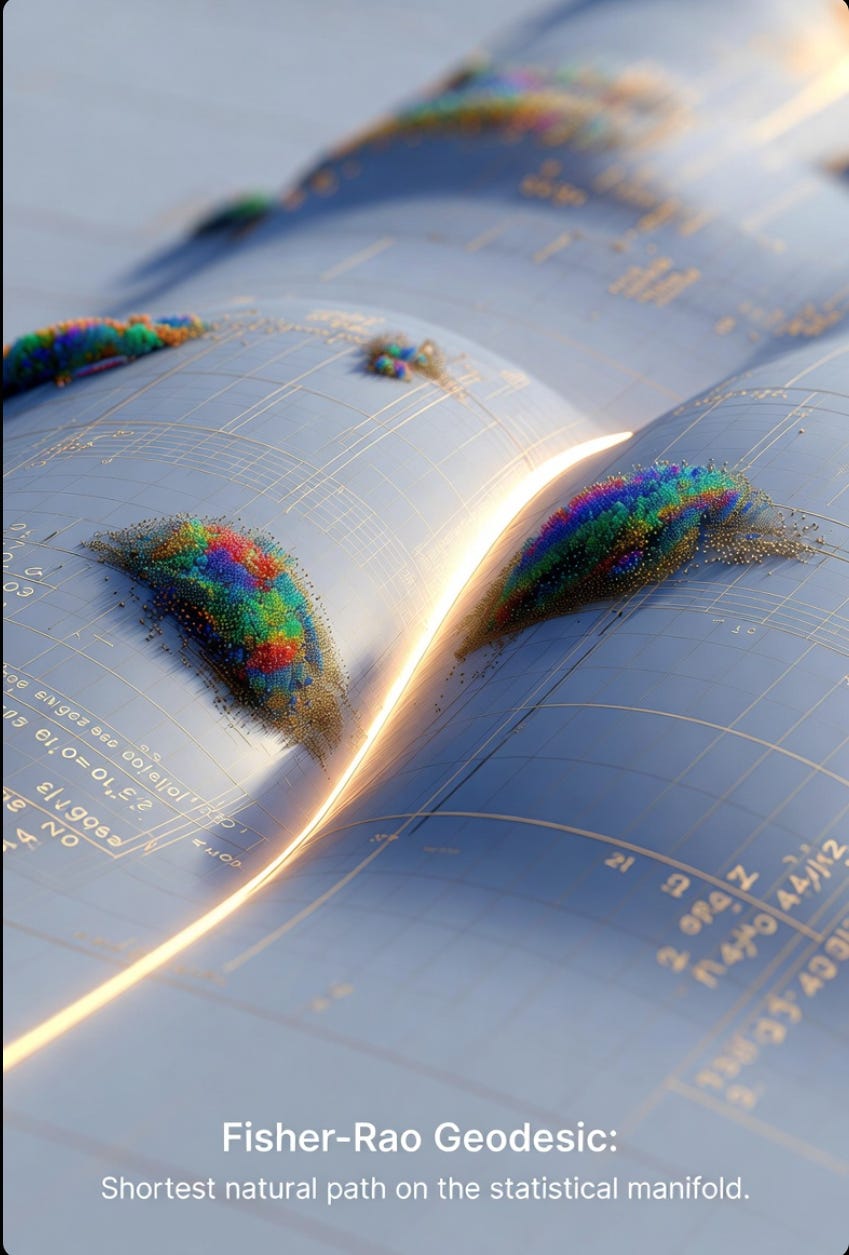
The Fisher-Rao metric is a natural way to measure distances on statistical manifolds those curved spaces where each point is a probability distribution. Unlike ordinary straight-line (Euclidean) distance, Fisher-Rao distance respects the intrinsic geometry of probability.
A geodesic is the shortest path between two points on this curved manifold, analogous to the great-circle route on Earth. In Fisher-Rao space, the geodesic shows the most natural, smooth deformation from one probability distribution (or shape) to another.
In practice, for shapes modeled as Gaussian mixture models, the Fisher-Rao geodesic computes the optimal path that morphs one set of landmarks into another while respecting the underlying statistical structure. This gives a geometrically meaningful similarity measure far better than simple point-to-point matching.
Visually, geodesics often appear as smooth, curved trajectories on the manifold — bent by the geometry rather than forced straight. They are the “natural highways” of probability space.
I’ll let you know when we get past the glitch. Your paper showed up at the right time. Nema passed along the other piece that influenced Russ and later led us toward information geometry via Amari & Ay.