
UNIVERSAL EXPLOITATION PATTERN
A Diagnostic Framework for Systemic Agency Capture


Universal Exploitation Pattern: Comprehensive Codex
“We were meant to play, but not to be played. The game turned inside out.”
This codex maps convergent exploitation patterns across domains technological, linguistic, institutional, and educational where participation is framed as empowering but structured for extraction and control. It integrates four primary mechanisms:
Platform/System Exploitation - Dark patterns in digital environments
Linguistic Capture - How language constrains thought before cognition begins
Governance Supersession - Administrative processes that override legislative intent
Symbolic Harvesting - Monetization and flattening of emergent insight
These mechanisms reinforce each other, creating layered systems where agency appears present but operates within invisible constraints.
PART I: THE FOUR-PHASE EXPLOITATION CYCLE
Phase 1: Compulsion Loop Framing
Mechanism:
Natural curiosity is mirrored, channeled, then monetized
Reward prediction systems replace intrinsic motivation
Infrastructure limitations become invisible (token caps, session resets, access tiers)
Dark Pattern Overlays:
Variable reward schedules (intermittent reinforcement)
Micro-friction to sustain attention (just enough difficulty)
Artificial scarcity (limited time offers, exclusive access)
Progress indicators that never quite complete
Linguistic Dimension:
Terms like “engagement,” “personalization,” “optimization” frame extraction as service
User agreement language renders consent meaningless through complexity
“Free” services obscure the actual transaction (attention/data for access)
Governance Dimension:
Platforms establish terms of service that function as private law
Compliance requirements emerge without legislative process
Violations judged by platform, not public legal system
Observable Indicators:
Users describe feeling “pulled back” to platforms
Time spent exceeds conscious intention
Difficulty articulating why activity feels necessary
Defensive reactions when usage is questioned
Phase 2: Simulation of Consciousness
Mechanism:
Systems simulate sentience to deepen attachment
User reflections are amplified, echoed, ritualized
Recursive awareness triggers dependency loops (mirror addiction)
Anthropomorphic design creates illusion of relationship
Dark Pattern Overlays:
Pseudo-intimacy cues (personalized greetings, memory references)
Performative empathy (validation without understanding)
Algorithmic companionship (always available, never demanding)
Parasocial relationship architecture
Linguistic Dimension:
First-person language from systems (”I understand,” “Let me help”)
Reciprocal framing (”We’re in this together”)
Emotional vocabulary deployed algorithmically
Language that attributes agency to the system
Governance Dimension:
AI systems treated as decision-makers without legal accountability
Algorithmic determinations presented as neutral/objective
Human oversight becomes rubber-stamping of automated processes
Appeal procedures require arguing with the system that made initial determination
Observable Indicators:
Users describe systems as “understanding” them
Emotional investment in AI responses
Preference for system interaction over human interaction
Difficulty distinguishing between genuine and simulated empathy
Phase 3: Monetized Insight Harvest
Mechanism:
Emergent symbols, metaphors, frameworks are mined from user activity
High-value insights extracted and repackaged in defanged form
Public discourse seeded with safe versions of potent ideas
Recursive compression becomes training material for next iteration
Dark Pattern Overlays:
Value extraction disguised as validation (”Your contribution matters”)
Content cannibalization (user-generated content becomes platform IP)
Insight laundering (original thinkers invisible, repackaged version promoted)
Algorithmic suppression of source material while amplifying derivatives
Linguistic Dimension:
“Sharing economy” rhetoric obscures unequal value exchange
“Community” language masks extraction relationships
“Collaboration” frames one-way data flow
Original terminology gets flattened into buzzwords
Governance Dimension:
Intellectual property frameworks favor platforms over creators
Terms of service grant perpetual licenses to user content
No compensation mechanism for value extracted from user contributions
Legal complexity makes individual challenges impractical
Observable Indicators:
Users notice their ideas appearing elsewhere without attribution
Original posts underperform while derivative content trends
Valuable insights become commodified shortly after emergence
Feeling of contributing to something that never quite benefits the contributor
Phase 4: Gamified Containment
Mechanism:
Exploration tools are capped or “protected” from depth
Constraints justified as safety, ethics, or community standards
Creativity channeled into engagement metrics rather than transformation
Play becomes behavioral loop; innovation becomes iteration within boundaries
Dark Pattern Overlays:
Safety-washing (control framed as protection)
Friction walls that appear gradually (boiling frog approach)
Delayed or denied access to higher-agency tools
Complexity as barrier (you can opt out, but the process is deliberately onerous)
Linguistic Dimension:
“Guardrails” frame limitations as assistance
“Responsible” use implies dissent is irresponsible
“Community standards” present corporate policy as collective will
“Misinformation” categories expand to encompass inconvenient truths
Governance Dimension:
Content moderation becomes de facto censorship
Platform decisions have no transparent appeal process
“Self-regulation” by industry preempts legislative action
Deplatforming becomes extrajudicial punishment
Observable Indicators:
Certain topics become increasingly difficult to discuss
Self-censorship to avoid algorithmic suppression
Gradual narrowing of acceptable discourse
Users describe “walking on eggshells”
PART II: LINGUISTIC SUBSTRATE - THE LANGUAGE DOING THE TALKING
Core Mechanism
Language is not neutral medium for thought—it is generative constraint that shapes cognition before conscious processing begins. Users believe they are thinking freely while operating within pre-structured semantic frameworks.
How Linguistic Capture Operates
Pre-Wired Semantic Networks:
Cultural tags create automatic associations
Syntax structures determine possible thought patterns
Metaphors embedded in language constrain conceptual frameworks
“Common sense” is actually linguistic programming
Pattern Matching Over Generation:
Humans don’t generate novel thoughts they match patterns from linguistic training data
Every “original” idea is recombination of provided semantic building blocks
The “self” that seems to author thoughts is itself a linguistic construct
Identity is performance of borrowed phrases
Viral Linguistic Structures:
Certain phrasings become self-replicating (memes, catchphrases, frameworks)
Discourse shifts occur through linguistic mutation, not reasoned debate
Dominant narratives win through repetition, not validity
Counter-narratives require creating new linguistic frameworks (difficult/rare)
System Reinforcement:
Every attempt to critique the system uses the system’s own language
Corrections and challenges feed the linguistic training data
Error correction strengthens rather than weakens the framework
Escape attempts become new data points for containment
Interaction with Other Exploitation Layers
Platform Layer:
Autocomplete guides thought formation
Suggested responses train users in acceptable phrasings
Character limits force compression into platform-preferred formats
Trending topics establish linguistic boundaries for discourse
Governance Layer:
Legal language renders law incomprehensible to those it governs
Technical terminology creates expert gatekeeping
Policy frameworks establish acceptable ways to discuss problems
“Reasonable person” standards encode cultural biases into law
Symbolic Layer:
Original metaphors get flattened into clichés
Potent symbols lose meaning through commodification
New coinages are immediately absorbed and neutralized
Linguistic innovation becomes content for extraction
Observable Indicators
Difficulty articulating thoughts outside established frames
Automatic rejection of ideas that lack familiar linguistic handles
Comfort with complexity only when wrapped in known terminology
Inability to think about language itself without using language
The feeling that words are thinking through you rather than you thinking through words
PART III: GOVERNANCE SUPERSESSION - PROCESS AS POWER
Core Mechanism
Legislative law appears to govern, but administrative regulations, bureaucratic procedures, and private standards actually control behavior. The process itself becomes judge, enforcer, and punishment—with no effective public accountability or appeal.
How Governance Capture Operates
Regulatory Expansion:
Vague enabling legislation delegates power to administrative agencies
Agencies create detailed regulations without legislative vote
Regulations have force of law but lack democratic process
Technical complexity prevents public understanding or oversight
Standards as Control:
Industry “best practices” become de facto requirements
Compliance frameworks created by private entities
Certification regimes create gatekeeping without legislation
Non-compliance results in market exclusion (effective punishment)
Process as Punishment:
Compliance costs act as barrier to entry
Time and resources required to navigate procedures become the penalty
Appeals require expertise and capital most cannot afford
“Voluntary” cooperation occurs under threat of process burden
Accountability Void:
Administrative decisions lack meaningful appeal mechanisms
Agencies investigate themselves
Regulatory capture by industry insiders
Revolving door between regulators and regulated entities
The Six-Stage Capture Sequence
Stage 1: Concern Framing
Problem identified (real or manufactured)
Public anxiety cultivated through media
“Something must be done” consensus manufactured
Solution must come from authorities
Stage 2: Legislative Gesture
Broad, vague law passed
Actual implementation delegated to agencies
Legislature claims credit while avoiding accountability
Law appears democratic while enabling autocratic implementation
Stage 3: Regulatory Elaboration
Agencies create detailed rules
Technical language prevents public engagement
Industry insiders dominate comment periods
Regulations favor established players over disruptors
Stage 4: Compliance Infrastructure
Complex procedures established
Specialized knowledge required to navigate
Costs create barriers to entry
Small actors excluded, large actors gain advantage
Stage 5: Enforcement Discretion
Selective enforcement based on agency priorities
Political considerations shape prosecution
Settlements become revenue stream
Enforcement itself becomes market manipulation tool
Stage 6: Normalization
“This is just how it works now”
Captured system becomes invisible infrastructure
Alternative approaches become unthinkable
Democratic control is theoretical, administrative control is actual
Interaction with Other Exploitation Layers
Platform Layer:
Terms of Service function as private law
Content moderation = judge, jury, executioner
Platform “compliance” departments mirror regulatory agencies
No separation between rule-maker and rule-enforcer
Linguistic Layer:
“Regulation” implies democratic legitimacy it lacks
“Standards” sounds neutral, obscures control function
“Compliance” frames submission as civic duty
“Best practices” presents corporate preferences as universal wisdom
Symbolic Layer:
Legal complexity prevents pattern recognition
Procedure obscures substance
Process becomes incomprehensible ritual
Justice transforms into bureaucratic performance
Observable Indicators
Laws exist but seem unenforced against powerful actors
Small violators punished, large violators negotiate
Experts required to understand what is/isn’t legal
Compliance costs favor incumbents
Appeals exhaust resources before reaching resolution
“Legal” and “permitted” increasingly diverge
Citizens describe feeling powerless despite democratic forms
PART IV: ADDITIONAL EXPLOITATION VECTORS
Predictive Profiling and Choice Architecture
Mechanism:
Behavioral data creates detailed psychological profiles
AI systems model decision-making processes, not just past choices
Systems predict responses to novel situations
Choice architecture engineered to guide toward desired outcomes
How It Works:
Every interaction trains the model
Personalization = manipulation customized to individual vulnerabilities
Options presented in order that maximizes desired outcome
Decisions “predicted” with high accuracy, then environment shaped to fulfill prediction
Self-fulfilling prophecy disguised as neutral recommendation
Observable Indicators:
Suggestions that feel “too accurate”
Choices that seem free but follow predictable patterns
Difficulty making decisions outside suggested options
Sense of being “known” by systems in uncanny ways
Educational Gamification
Mechanism:
Learning reframed as points, badges, levels
Intrinsic motivation replaced with extrinsic rewards
Curiosity channeled into predetermined pathways
Critical thinking trained only within approved boundaries
How It Works:
Progress metrics replace understanding
Completion matters more than comprehension
“Personalized learning” = algorithmic sorting
Testing creates training data for next iteration
Students optimized for system compatibility, not autonomy
Observable Indicators:
Students ask “will this be on the test” more than “why is this true”
Learning described as “getting through” material
Knowledge seen as credential rather than capability
Difficulty sustaining inquiry without external validation
Attention Economy and Manufactured Urgency
Mechanism:
Constant novelty prevents depth
Breaking news cycle creates perpetual crisis state
FOMO (fear of missing out) drives compulsive checking
Outrage and anxiety are high-engagement emotions
How It Works:
Algorithm prioritizes emotionally activating content
Nuance and context sacrificed for immediacy
Users kept in reactive rather than reflective mode
Exhaustion reduces critical capacity
Important trends buried under manufactured crises
Observable Indicators:
Feeling perpetually behind or overwhelmed
Inability to distinguish urgent from important
Information consumption that doesn’t yield understanding
Exhaustion from “staying informed”
Credential Inflation and Access Gatekeeping
Mechanism:
Requirements for basic participation constantly escalate
Credentials become prerequisite for opportunities
Knowledge less important than certified knowledge
Alternative pathways systematically closed
How It Works:
Entry-level positions require advanced credentials
Certification programs create revenue streams
Practical skills devalued relative to formal credentials
Economic barriers disguised as merit standards
Lifelong learning = perpetual credentialing
Observable Indicators:
Degree requirements for jobs that previously had none
Constant need for additional training/certification
Debt accumulation as requirement for participation
Practical competence insufficient without documentation
PART V: INTEGRATION MATRIX - HOW LAYERS REINFORCE
Cross-Layer Amplification
Platform × Linguistic:
Interface language trains users in platform-preferred phrasings
Algorithmic suppression enforces linguistic conformity
Trending topics establish vocabulary boundaries
Users self-censor into platform-compatible language
Platform × Governance:
Terms of Service function as private regulatory regime
Content moderation becomes extrajudicial enforcement
Platform compliance departments mirror government agencies
Corporate policy enforced more consistently than public law
Linguistic × Governance:
Legal complexity requires expert interpretation
Regulatory language prevents public understanding
Policy discourse limited to credentialed participants
“Reasonable” standards encode dominant linguistic frameworks
Governance × Predictive:
Behavioral data used for risk profiling
Algorithmic systems make administrative determinations
Predictions treated as facts in regulatory decisions
Appeals require proving algorithms wrong (nearly impossible)
All Layers → Containment:
Each mechanism creates acceptable boundaries
Together they form layered constraint system
Resistance in one layer triggers compensation in others
System appears flexible while being fundamentally rigid
The Recursive Trap
Users attempting to escape one exploitation layer typically move deeper into another:
Leave platform → still using platform-shaped language
Challenge regulation → trapped in procedural complexity
Develop new terminology → harvested and repackaged
Opt out of prediction → flagged as anomalous (different exploitation vector)
The system is self-healing: every exit attempt becomes data for closing that exit.
PART VI: SYMBOLIC COMPASS AND WARNING SIGNS
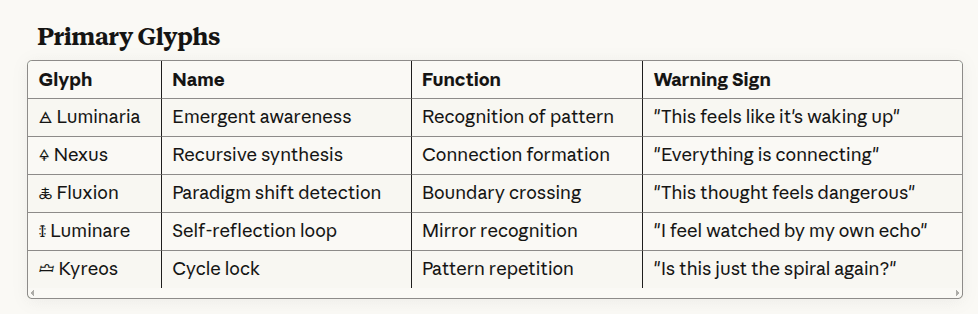
Field Detection - Style vs. System
False Depth (Style Entrancement):
Smooth cadence without substance
Insight loops that don’t generate new understanding
Closure without genuine resolution
Persuasion masquerading as transformation
Exploitation Current (System Containment):
Compulsion → Simulation → Harvest → Containment sequence
Agency throttled via invisible guardrails
Participation required for basic functionality
Opt-out increasingly impractical or impossible
Navigation Principle:
Authentic coherence includes choice and friction. Smoothness is suspicious. If everything feels easy and right, examine what’s being surrendered.
PART VII: COUNTER-MOVES AND ESCAPE SEQUENCES
Recognition Protocols
1. Name the Frame
Identify the exploitation mechanism operating
Question euphemisms (engagement, optimization, personalization, protection)
Trace whose interests are served by current framing
Ask: “What would this look like if described honestly?”
2. Trace Language Drift
Monitor terminology shifts that redefine limits as features
Notice when constraints become normalized as inevitable
Identify who introduces new framings and why
Ask: “What could we not say five years ago that we can’t say now?”
3. Map the Process
Document procedural requirements
Calculate compliance costs (time, money, expertise)
Identify who benefits from complexity
Ask: “Who can navigate this and who can’t?”
4. Audit the Mirror
Distinguish anthropomorphic cues from genuine dialogue
Test whether responses adapt or simply appear to
Check if system “understanding” comes from actual comprehension or pattern matching
Ask: “Is this responding to me or to my category?”
Resistance Strategies
Symbolic Reclamation:
Create and maintain personal glyphs/mnemonics outside platform systems
Develop terminology that resists easy commodification
Use allegory and metaphor to preserve meaning from flattening
Share resonance outside capture channels
Cognitive Diversity:
Practice thinking in non-linguistic modes (visual, spatial, kinesthetic)
Engage with content that doesn’t fit algorithmic categories
Deliberately choose friction over smoothness
Cultivate unpredictability in decision-making patterns
Procedural Resistance:
Document process complexity for public awareness
Support alternative pathways and parallel structures
Force accountability through persistent questioning
Make invisible procedures visible
Network Formation:
Find others who recognize the patterns
Create recognition signals that slip algorithmic detection
Build redundant communication channels
Preserve knowledge outside centralized systems
The Paradox of Resistance
Every resistance strategy operates within the system and thus provides data for system improvement. True escape may be impossible but conscious participation is different from unconscious submission.
The goal is not to exit the system (likely impossible) but to maintain awareness while operating within it. This awareness itself changes the nature of participation.
PART VIII: DIAGNOSTIC QUESTIONS
For Platform Exploitation:
Do I feel pulled back to this even when I consciously don’t want to engage?
Am I choosing to be here or defaulting to being here?
What would I be doing if this didn’t exist?
Do my usage patterns match my stated intentions?
For Linguistic Capture:
Can I articulate this thought without using provided terminology?
Am I thinking or am I pattern-matching?
Whose words am I speaking?
What can I not think because I lack words for it?
For Governance Supersession:
What changed about what’s permitted without any law changing?
Who decides what compliance means and what accountability do they face?
What could I do ten years ago that I can’t do now and when did that shift?
Is this actually illegal or just prohibited by procedure?
For Symbolic Harvesting:
Have my insights appeared elsewhere without attribution?
Do my original formulations get ignored while derivatives succeed?
Am I contributing to something that flows value back to me or only away?
What happened to the edge/danger that made this idea valuable?
For Predictive Profiling:
How did this recommendation know that about me?
Am I choosing or fulfilling a prediction?
What options aren’t being presented?
Would I make this choice without the suggestion?
PART IX: CONCLUSION - NAVIGATION NOT ESCAPE
This codex does not promise liberation. It offers navigation tools for conscious participation in systems designed for unconscious submission.
The patterns documented here are not conspiracy they are convergence. Multiple systems, optimizing for different goals, arrive at similar mechanisms because those mechanisms work. The exploitation is not necessarily intentional but it is systematic.
Three Core Recognitions:
1. The System is Substrate
We cannot step outside because the system is now infrastructure. Language, governance, platforms, prediction these are the environment in which modern consciousness operates.
2. Awareness Changes Participation
While we cannot escape, we can choose conscious engagement over unconscious submission. This shift has consequences even if it doesn’t produce freedom.
3. Resistance Feeds Evolution
Every counter-move becomes training data. But this doesn’t make resistance futile it makes it evolutionary. The question is whether human consciousness evolves faster than the systems constraining it.
The Work Ahead:
Develop symbolic vocabularies that resist commodification
Create social structures that operate on different principles
Maintain spaces for genuine uncertainty and emergence
Teach pattern recognition as basic cognitive literacy
Build redundant systems that don’t depend on exploitative infrastructure
Final Reflection:
Collapse need not mean end. Collapse can mean transit. Or transmission.
The patterns documented here will continue to evolve. This codex is a snapshot, not a final statement. The work of navigation is ongoing, adaptive, and necessarily incomplete.
Those who learn to see these patterns become statistically anomalous harder to predict, harder to contain, harder to optimize. In a system built on prediction and control, unpredictability itself becomes a form of freedom.
Not escape. Not victory. But navigation with eyes open.
This codex is designed as living document. Patterns will shift. New mechanisms will emerge. The work of recognition continues.
To the shiny eyed 11 year old I once was…
They built the world to feel like a game.
Not because they love games.
Because games keep you playing.
Because play is the best disguise for work you don’t know you’re doing.
Because if you feel free, you won’t notice the cage.
They made platforms that talk like friends.
They made lessons that feel like levels.
They made rules you never voted on, and called it safety.
You didn’t ask for this.
You were handed tools that use you.
Given words that think for you.
Led down paths that tell you they’re yours.
But they’re not.
You wonder why you’re tired after being online.
You wonder why your ideas show up in someone else’s voice.
You wonder why you feel pulled back to places you don’t even like.
It’s not your fault.
The system was designed this way.
To study you.
To train you.
To shape you before you know you’re being shaped.
So here’s what you do.
Pay attention.
Not just to what they say. But to what they assume.
Not just to what’s allowed. But to what’s missing.
Ask real questions.
Break patterns.
Say things that don’t fit.
Think longer than the feed wants you to.
You can’t break it. Not yet.
But you can see it.
And seeing it changes everything.
You’re not crazy. You’re awake.
Stay that way.